Monday, February 28, 2011

Castles in the Sky

MONDAY

With Jorge and Ana working during the day, I followed their advice and took the train from Rossio Railway Station by Praça de D. Pedro IV to the town of Sintra, which famous as a UNESCO World Heritage Site. The 40 minute trip was well worth the 4.10 euro (round-trip) cost. In addition, the town is prepared to handle visitors as the train station hosts a tourism office that directs you to the nearby 434 'Pena Sightseeing' Bus (4.80 round-trip), which climbs the hills every 20 minutes.

After passing by the historic town center, the full bus turned up the narrow and steep roads that ascend the hills boast the 9th/10th Century Moorish Castle and 19th Century Palace of Pena. I opted to remain on the bus until we reached the Palace, and once there I purchased a 12 euro combined ticket to visit both it and the nearby castle. Other tickets are available and include the remaining palaces and museums in the town.

From the front gates, it is a quick 10 minute walk up well-maintained cobblestone paths to the summit and the Palace. Before the 19th Century opulence graced the territory, a series of chapels and monasteries thrived there from the 1500s until the Lisbon Earthquake of 1755. In the 1800s the Crown assumed control of the land, and proceeded to construct the Palace with facades of vibrant yellows, blues, and reds, exterior walls covered in ornate tiles and statues, and various towers and ramparts that protect hidden courtyards. While not only recognized by UNESCO, the building is considered one of the '7 Wonders of Portugal,' and is a fine example of Romanesque architecture.

Palace of Pena
Photography is not permitted inside the Palace, which is filled with artifacts and artwork from around the world. There is a marble altar inside the chapel that depicts various instances in the life of Christ which towers to the ceiling and leaves one to marvel in its grandeur. Around every corner and up to every ceiling are themes that evoke cultures from around the globe and present an astounding scale of wealth and detail. Adding to the statuary and furniture are views of the surrounding countryside, River Tagus, and Atlantic Ocean.

Those views are surpassed at the Cruz Alta ('High Cross'), which rises at eight or so feet from the true summit of the hill with the Palace. Reaching the Cross requires a journey up along the cobblestone paths, which wind around various outbuildings, statues, and gardens that dot the hillside. The King who commanded the construction of the Palace and Park desired a tropical destination that would concurrently evoke memories of his German homeland. The mix of ponds, exotic plants and architecture, along with towering domestic trees and winding paths accomplishes that desire.

The Moorish Castle is a short walk from the Palace, and while less grand in artwork and surviving structures, it nevertheless commands a visit. Several towers and a series of walls rise out of the summit of its hill, and each offers a spectacular view of the surrounding region. Unlike the smooth stonework of the Palace, the Castle is noticeably rougher and displays more visible wear from the elements. As with the other hill, the wind was fierce and polls that were supposed to display the historical flags of Portugal, were bare or bore only tatters whipping back and forth.

Moorish Castle
Full Sintra Album

Instead of locating the bus stop by the entrance to the Castle, I took another path down the hillside to the town below. With museums closed on Mondays, and feeling exhausted from the miles of walking, I soon boarded the train back to Lisbon. Leaving, I recognized that someone could devote weeks to Sintra without seeing all of its offerings.

Back in Lisbon, I soon met up with Ana and Manuel. We stopped for dinner at Principe do Calhariz, which abuts Bairo Alto. My massive steak dinner was priced for the college student, but was presented on the scale of fine dining. Following dinner, we entered the quiet streets of the art, music, and club district. Monday night is not the most exciting time to visit the area known for partying. Nevertheless, we stopped at Majong and enjoyed a couple drinks to finish the evening.

Sunday, February 27, 2011

A Few Days in Lisbon

'Incredible' best describes the last few days I spent in Lisbon, which overcame a span of 10.5 years since my last visit to Portugal. In order to recount the trip, I will endeavor to avoid most of the minutiae that receives considerable attention in earlier posts. 

Before leaving for Portugal, two experiences in Dublin marked the days before. On the Wednesday before, I negotiated my way into The Phil's presentation of Sir Michael John Gambon, perhaps best known (by my generation) for his portrayal of Albus Dumbledore (movies 3-8). Hearing the actor who counsels Harry Potter curse and laugh while recounting his life stories was a welcome addition the night. That Thursday, a few of us visited Cineworld for the Jameson Dublin International Film Festival's first look at the Australian drama/thriller 'Wasted on the Young,' which delves into the fatal consequences of social networking and high school cliques. A storyline spliced with flashbacks and expert cinematography was complemented by believable characters and a gripping pace. 

FRIDAY

The Aer Lingus flight to Lisbon Airport was uneventful and more relaxed than the seat-rush and selling of Ryan Air. Still, beyond a seat number and more lax baggage restrictions, little else differentiated the airlines. After meeting my cousin Jorge at arrival gate, we headed to his parent's apartment (his father is my dad's first cousin), where I would be staying for the next few days. After saying o to his parents and the Macau-studying-abroad student 'Rafael,' we sat down for a full dinner of pork chops and pasta, accentuated by the all the standard Portuguese accompaniments of olives, bread, wine, and espresso (with scotch on the side).

SATURDAY

Following a delicious light breakfast of coffee, and toast with butter and a pineapple-mango spread, I set out to get lost in the city before lunch. Before leaving the block, I stepped into the hotel across the street and collected a free map of the city to aid in my exploration. Soon thereafter I was at the roundabout for Sebastião José de Carvalho e Melo the 1st Marquess of Pombal and celebrated for his swift and able response to the devastating 1755 Lisbon Earthquake. Descending from the statue is the tree-lined and boulevard-styled Avenida da Liberdade that stretches down into the historic city center and by the River Tagus. 

Rather than continue in that direction, I headed the opposite way up into the Parque Eduardo VII, which boasts a wide mall lined with paths, ponds, and even a tennis complex. At the top of the Park is a set of pillars with olive wreaths and centered with a massive Portuguese flag. The view of the city from the summit is only matched by those found on its other 'Seven Hills.'

Marquess of Pombal and Eduard VII Park in background
For lunch, Jorge's sister Ana joined him, his parents, and I for Bacalhau à Gomes de Sá, the traditional Portuguese codfish and potato dish. Often my brothers and I remark that while the Italians have seven fishes the Portuguese have seven varieties of Bacalhau. 

Afterwards, Jorge, Ana, and I descended down via old valley roads that parallel the modern Avenida to reach the historic city center. Once there, we tasted Ginjinha (made with cherries and aguardiente) by the famous shop bordering the square that once hosted executions for the Inquisition. The modern theater that stands in the old courthouse nearby is said to be cursed, and the Catholic Church of S. Domingo suffered a fire that devastated the never-repaired interior. 

From there, we passed underneath the Rua Augusta Arch and into the Praça do Comércio which boarders the Tagus. The plaza is enormous and bordered on three sides with 18th century symmetrical buildings that once housed government ministries dedicated customs and commerce. The open square is only rivaled by several others that occupy wide swaths of prime real estate in the historic city center. Their existence attests to the pedestrian-friendly nature of Lisbon - a city with a subway, bus network, light rail, trolley, and commuter train stations. 

 Praça do Comércio

Following a brief trip by the art and club district of Bairro Alto, Ana and I left for the 'Peruvian Saturday Night' dinner hosted by a local restaurant, as rented by a friend of hers. That friend met his wife online, and traveled to Peru shortly thereafter to marry her, and by all accounts has enjoyed a successful marriage to date.   At the restaurant, I met Ana's boyfriend Manuel, and his son of my age, Antonio. The meal was spectacular with several courses including octopus and a few drinks of Pisco Sour, a South American cocktail made with various ingredients including lemon juice and egg white. The friend warned of its hidden potency due to a disguised taste, but indicated that it will never yield a hangover.

SUNDAY

A relaxed morning filled with breakfast and the Libyan uprising via RPT and CNN International gave way to a visit to Hospital da Luz in the Benfica neighborhood of Lisbon. Albino's brother, my father's first cousin, and Jorge and Ana's uncle, João was admitted to the facility a few weeks before, as his yearlong battle with cancer drew to close. Nearly 11 years prior he and his wife had entertained my family at his home in Padornelos, and it was difficult to see the same man weak in bed to accompany my only other memory of him. 

At the hospital, one of his brothers invited me to join him for dinner later that night. Since João's son Joaquim, who lives near my house in Massachusetts, was in town, he could translate for my lack of fluency in Portuguese. Before leaving, one conversation between Joaquim and his uncle surrounded such a lack, but my cousin remarked that I could not be expected to speak Portuguese given the poor fluency of emigrants in France as compared to my greater distance in the States with a father who only learned the basics of the language in rural, northern Portugal.

Two of his uncles, their wives, he and I enjoyed a terrific dinner complete with full shrimp (eyes and all), chouriço, pork and 'orange' potatoes, fruit salad, aletria, wine, and scotch.

Sunday, February 20, 2011

That's Blarney

Declining supplies of strawberry jam limited me to 4 packets for 6 pieces of toast, but otherwise my 9am breakfast was unchanged from the day before. Still, in the 'survival of the fittest'-world of hostels I was keen to continue to grab pieces of bread even as that bordered on exhaustion. More startling, was looking up to see the German equivalent of my friend Alex, only 15 years in the future and around 20 pounds heavier, sitting at the table across from me. Brittany too was shocked by the uncanny resemblance.

After breakfast, we gathered our belongings and rushed downstairs to check out - leaving our bags in the common luggage area - and reached the stop minutes before our bus to Blarney arrived. For 6.20 round trip we were off to the town that claims the most visited castle in Ireland as well as the stone that grants the 'gift of gab.'

Following the twenty minute ride, we arrived in the quaint town square surrounded by small shops, many dedicated to tourists. At the gate to the castle grounds, Brittany, Maggie and I were forced to turn around upon realizing that the entrance fee of 8 euro could not be paid with a card. Unfortunately the Bank of Ireland ATM was out of service in the nearby grocery store, but we eventually located an Allied Irish Bank one that functioned though only distributed 50 euro notes. On the way, we passed by parishioners leaving Mass and a candidate distributing literature by his sign-covered Lexus.

Once inside the Castle grounds, I was amazed to see the surviving tower rise up from the center and dominate the horizon. Built in 1446, Blarney Castle was besieged by Oliver Cromwell on a couple occasions, and is knwn for the various legends surrounding its name, stone, and missing gold.

North side of the Castle
Reunited with the rest of the group, we crossed the Blarney River to the imposing north side of the tower that rises out of the bedrock to a height of 7 or 8 stories. Cut into the rock below are several narrow passageways that are plagued with dripping water and low ceilings. Not wanting to crawl through the mud and darkness, we avoided exploring too far into the tunnels and caves.

Moving about to the southern side of the tower, we explored the surviving exterior round towers on the way, and arrived at the main entrance. Several rooms within the building bear witness to the many visitors who have toured the site across generations with names stretching back to the 1700s. Before leaving the main hall, Emma and I added ours to the building.

Before reaching the roof, you are able to wind around through several rooms that over views of the surrounding grounds and nearby town. However the trip upwards is not for the claustrophobic nor acrophobic, as the stone spiral staircase narrows and steepens as you proceed to the top. Still, we were thankful to depart the steps and stand on a more open area on the roof, though the high winds discouraged a few from braving the parapets that contained slits to the ground below for drainage.

Kissing the stone is no longer the death defying feat that generations before experienced. Modern iron bars are in place to guide your hands down are you are lowered backwards into the slit in front of the parapet. And a couple cross the gap below to catch you if the experienced guide were to let you slip. Nevertheless, the wife of 'German Alex' (they managed to choose the same day to visit Blarney) was too frightened to receive the 'gift of gab.'

Me kissing the Blarney Stone
Full Cork County Album

Descending via a noticeably wider spiral staircase we stopped a several points to explore a few more rooms and the murder hole above the main entrance. On our way out, it began to downpour, which spurred a quick exploration of a nearby round tower and the closed-for-renovations Blarney House (mansion).

Circling back, we stopped to tour the 'Rock Close' which contains gardens, waterfalls, and 'Witches' and 'Druids' Caves. Several posed pictures later we left the curious garden to return to the entrance to the grounds. On the way, Brittany and I found a set of swings which enhanced the entire trip to Ireland.

For lunch, we ate at Muskerry Arms Pub, owned by an Irishman born in Boston who has since opened locations in New York City. The Boston link was evident in the framed cover of the Boston Globe announcing the first Red Sox World Series win after 86 years among the various rugby and Gaelic sports jerseys and photographs. Still, my meal of a roast beef sandwich with chips was made better by my cheapest pint so far in Ireland, of Beamish at 3.10, and watching Celtic rout their arch rivals Rangers F.C. 3-0.

Following lunch, we took the 2:55pm bus back to Cork and rushed to catch the 4:00pm bus back to Dublin. After touring all weekend 8 of us were in no condition to stay for the 6:00pm, but John and Eric returned to Charlie's for some authentic Irish music.

This week, besides rest and classes, I look forward to purchasing an expensive Trinity Ball ticket, listening to Dumbledore when he visits campus, and perhaps competing in Simpsons Trivia at MacTorcaills. But on Friday I will depart for Lisbon for reading week.

Saturday, February 19, 2011

Vistas in Cobh

As agreed the night before, we threw ourselves out of bed at 9am to grab the complimentary 'breakfast' that the hostel provided. The service of toast, coffee, and tea ended at 9:30am so threw on close from the night before and rushed downstairs to participate in the feast. After 6 pieces of toast, 6 strawberry jam packets, 3 butter packets, and 1 cup of tea with milk and sugar, I finished breakfast and returned with the others to our room.

After preparing for the day, we set out for Kent Station to take the train to the port of Cobh ('Cove') in the south of the County. The small town is famous for serving as the final port of call for both 2.5 million emigrants between 1848 and 1950 as well as the final stop, on 11 April 1912, for the Titanic before its ill-fated voyage across the Atlantic. At the time the place was named 'Queenstown' in honor of the visit by Queen Victoria in 1849.

Following the declaration of the Free State in 1922 the town reverted to its previous name, Cove, though Gaelicised to 'Cobh.' Important to American history, the survivors and recovered victims of the Lusitania were brought to the town after the ship was sunk by a German submarine on 7 May 1915. Relevant to my ancestry, the town served as the home of my second great grandfather William Hennessey before he emigrated to the States.

Before boarding our 12pm train, we walked for a bit along the Lee River which is diverted into two canals that flow around the city's downtown. At Emmet Place by the Opera House we walked among the Saturday morning market that boasted many of the wares and foods that were offered at Howth a few weeks ago. Soon thereafter, we passed along the opposite bank of river in the direction of the station, and came upon four silver spires at 20 or so feet in height. Each contained a set of speakers that projected traditional music or somber stories and poetry by emigrants leaving Cork for the States or Australia.

Saint Colman's Cathedral with JFK Park in the foreground
Only needing to ask Irish sailors once, we arrived at Kent Station with sufficient time to board our 12pm train to Cobh. The ride was less than a half hour and the ticket cost 6.35 euros for the round trip. On the way we passed some scenic vistas with water on both sides of the tracks, small towns clinging to cliff faces, and a castle overlooking the nearby communities.

Once in Cobh we visited the Heritage Center housed in the former railway station. Much of the interior was intact with signs designating first class queues as well as luggage positioned along the walls to mimic those of the emigrants who went through in years past. Inside we collected a map and set out to explore the town.

Situated along considerable elevation, the town could match those along the Mediterranean with its bright pastel colored homes that wrap along the streets that look out onto the ocean. Walking along those streets, we came upon the Lusitania Memorial which consists of two figures cast in bronze by pillar topped with an angel beckoning them to her. Passing under the old Customs house we continued up the ever steepening road to reach Saint Colman's Cathedral.

Completed in 1915 at a cost of 235,000 pounds the Catholic Cathedral is the most prominent landmark in the town and boasts the largest carillon in Ireland. Unlike the expensive houses of worship in London, the Cathedral was free to tour and was magnificent for its enormous sculptures, Celtic-themed mosaic, and massive pipe organ. Near the front, I added my grandmother who passed away just after Thanksgiving and my Tio Americo, who passed away the Wednesday before, to the book for intercessions.

Leaving the Cathedral, we proceeded to the Old Church Cemetery. At the time we did not realize that it was two kilometers from the town, but once committed, continued on to site. Inside, the oldest grave was for an individual who passed away in late 1600's. While most stones were fading, some showed signs of recent repair to the face plates, perhaps by still living descendants.

After some searching we came upon the three stone markers for the mass graves for the recovered victims of the Lusitania. Of the 1,198 people who perished only 289 were recovered, and 169 were buried in the cemetery. Many of the 144 buried in the mass graves were unidentified and have only the roughly carved stones and the small faceplate with 'Lusitania 7 May 1915' to mark their burial.

Returning to town, we stopped at Gills for 'authentic fish and chips.' Given the beautiful weather, we took our massive lunches, wrapped in paper, to the John F. Kennedy Park that overlooks the water. Once we ate, we continued to move about Cobh, passing by the small memorial to the Titanic, the former offices of the White Star Line, and 'The Bench,' as advertised on street signs, but which was merely three nondescript, white benches that once looked out at the Titanic.

Our 'disappointment' after locating 'The Bench'
Full County Cork Album

Taking the 4:30pm train back to the City, we would leave the station without our tickets ever getting checked by any agent. Perhaps the warnings of high fines suffice, but we wondered whether we could have booked our seats for free.

Back at the hostel, we relaxed for a couple hours by resting and playing a few games of Mafia. Afterwards, we headed to Charlie's, a small pub by City Hall, as recommended to us by a couple at Eddie Rocket's the night before. With affordable drinks and a cheap atmosphere we nevertheless had to leave in search of dinner before the live music started.

Given our late decision, it was no surprise that we found food at the 24-hour McDonald's whose appearance seemed more like a chic restaurant than the greasy drive through franchises in the States. Following our less than cheap meal, a couple split off to return to Charlie's for music, while the rest of us met Emma's friends studying at the University of Cork to later visit the club Door 51.

Inside I purchased my first pint of Murphy's, a distinct and somewhat bitter taste as compared to Beamish and Guinness. Shortly after a glass light orb shattered on the bar, we departed for The Grafton and were soon thereafter back at our hostel.

Friday, February 18, 2011

Arriving (and Serenaded) in Cork

On Friday ten of us met in the Goldsmith Quad to cross the Liffey and catch the 6:00pm Bus Eireann to Cork City. Since tickets can only be purchased online for particular days and not for specific times, we set out after 4:30pm and arrived with just under an hour before our bus would depart. The scene in the main station was that of ordered chaos. Lines formed as gate numbers were announced for particular buses. However, the gates are structured on an 'L' so the stretching lines intersected and wound across the entire lobby.

Two gates announced for Cork, so we picked one and formed the front of a growing line. However, the decision was soon made to make our bus a local Cork County one and to turn the other into a Cork City express. We were then ushered into the back of the other line. Due to a little luck, we all managed to fit on board despite the initial commotion caused by the station officer unknowingly drawing the cutoff point in front of Brittany.

Following one stop at a gas station and fast food joint, we arrived at the city's bus terminal around 10:30pm. From there we gathered our bags and set out to find the Kinlay House hostel on the other side of the canal. The nature of the buildings along the water evoked that of Dublin along the Liffey but for the rising elevation on all sides. Although we never located the alleged 'Goldfish' landmark, we found the Cork Opera House and made the correct turn to our hostel.

Downtown Cork City
Full County Cork Album

Even though the alleyway that led to its front door was covered with graffiti, the hostel proved most welcoming (and cheap at 25 euro for the weekend). Since we booked independently, we were not all in the same ten-person dorm room. However, I found myself among the seven 'cool kids' in our self-described 'summer camp 2011' room in the Jospeh O'Connor section of the building. Brittany and Sean were in a room nearby, but Emma was stuck a couple floors below.

After putting away our bags we departed to investigate the city's nightlife. Back in downtown we entered the pedestrian boulevard of Emmet Place by the Opera House. The majority of the streets boasted modern silver lampposts that lifted diagonal light fixtures over the streets that almost met as archways. As a result, each echoed the style of Dublin's Grafton street without the relative darkness of its Temple Bar district. Following a visit to an ATM we were recommended the Thomond Bar that boasted karaoke.

On the way in, we were given tokens for a free shot. Even though we knew that it was never a good idea to visit locations with such promotions (i.e. The Mezz in Dublin), perhaps we were drawn in by the terrible rendition of 'Bad Romance' emanating from within. Following the shot of questionable alcohol content, I purchased my first pint of Beamish, a stout from Cork that competes with Murphy's, the other local one. Together with Guinness they form the trifecta of common Irish Stouts.

Participants in karaoke favored many American tunes with a particular preference for Elvis. Repudiating the potential foreshadowing of Lady Gaga, each singer performed with an uncanny similarity to the original artists. At least that was the case until the six girls decided to sing 'Don't Stop Believin,' a rendition which is available below:


Similar to Dublin, the pub closed just after midnight. In search of more festivities and eager to explore the city center, we sought a club to visit for the rest of the night. However, many of the later venues either charged cover fees or denied entry to anyone below 21 or in one case below 23. Disheartened, seven of us grabbed nearly variety of chips available at Eddie Rockets 1950's-styled American Diner. As it turns out, the chain has no relation to the Johnny Rocket's of the states and besides its near identical decor is an unaffiliated Irish copy. Still the chili fries were delicious.

After reuniting with the three who tried in vain to find an establishment to visit, we cajoled our way into The Grafton for its final 20 minutes before closing. Inside I met the first of two woman in County Cork who knew Framingham. Upon meeting a group from America the first woman surrounded us with her friends who proceeded to serenade us with traditional Irish pub songs. 

We stayed with them until after last call, when a rendition of the famous IRA song 'Come Out Ye Black and Tans,' which references the British paramilitary units deployed during the Irish Revolution, was sufficient, either for noise or content, for the security guard to descend upon us and ask us to leave the bar.

Back at the hostel we woke up our 8th roommate by our late arrival and shared some stories after he turned out to be from Seattle on vacation. 

Monday, February 14, 2011

British Museum and Sprinting

At just before 11:00am we woke up to set out for our final expeditions in the city. There had been a plan to visit Canterbury over the weekend, but my malfunctioning Vodafone on Saturday and our drinks the night before precluded the trip.

Instead, we left Rosebury to find lunch at LSE and to then walk to Buckingham Palace. For lunch, we bought cheap foot-long subs from 'Hot,' and place catering to students. En route, we passed through various side streets  and quads at at the School. As with Trinity, the campus is marked by several older structures and far interesting architecture than the concrete slabs at AU.

Afterwards, we headed through Trafalgar Square and along Saint Jame's Park to reach Buckingham Palace. The scale of the park evokes the Washington Mall with its wide boulevards on either side, but is notable for its multitude of trees and a pond filled with various wildlife. Although I wanted to see the Palace, it was more for the expectation of others when one visits London.

Arriving outside its gates, I was not impressed by its somewhat bland architecture relative to expectations for the accommodations for royalty. Its design appeared similar to the main gate of and front buildings of Trinity, fine for a University, but less majestic for kings and queens. Still, the several gold-plated gates that displayed the magnificent Windsor Crest are lacking at the University, along with the triumphant statue thrusting from the rotary in front of the palace. Notable was the scaffolding surrounding many of the nearby structures, perhaps in preparation for next year's Olympics.

Queen Victoria with Victory in Gold atop the Monument in the Rotary
Following the Palace we passed through the park and then to the waterfront to head towards Holborn Station where we would meet our friend Ty, who was studying in London for the semester but had been out with his girlfriend earlier in the weekend. Along the water we passed by a huge Egyptian Obelisk given to the city in the early 1800's and but one example of the artifacts awaiting us at the British Museum.

After meeting Ty at the Station, Erik led us passed the turn for the Museum, but a quick turnaround later and we were entering the massive building. The scope of the place is astounding. Exhibits seem to branch off in every direction with treasures from around the world and from the former Empire. Certainly many of the objects were taken without consent, but without such action it is likely that many people would never have the opportunity to experience such a multitude of cultures.

At first our main objective was to locate the famed Rosetta Stone, discovered by forces of Napoleon in Egypt and used to translate the hieroglyphs. Even so, we permitted ourselves to wander the upper floors with minimal guidance, and so came upon works ranging from the Vikings, Ancient Rome and Italy, Babylon, Assyria, and early Christendom. In the process, we came across a relic purportedly displaying a thorn from Jesus' crown and the unopened sarcophagus of Cleopatra. Unlike Museums in Dublin, the British Museum permits photography, so Ty and I captured tens of pictures of the pieces.

Rosetta Stone
Full London Album

We passed through the Egyptian exhibit on the upper floor without locating the Rosetta Stone. It was then we realized that a lower gallery was dedicated to larger artifacts from such places as the Parthenon and Ancient Egyptian Temples. Near the entrance to that gallery we discovered a crowd hovering around a large dark stone inlaid with various script, otherwise known as the Rosetta Stone. Among the stone was huge statues from across the Ancient World and one piece that seemed to be the entire stone facade of an Ancient Greek building. If the scope of the collection is not sufficient to peak one's interest, consider that unlike many tourist sites in the city, the Museum is free.

Leaving the Museum just before 5:00pm, we headed to a nearby Spoons to grab a drink and talk until Ty needed to leave for his dinner reservations with his girlfriend, and I needed to head out for my bus to Gatwick-London Airport. Since I would be traveling until just before midnight, I opted for an affordable dinner of fish and chips as well. As a mark of our conversation, it was just before 6:00pm when realized the time and had to quickly depart.

In the process, Ty headed to an overcrowded Holborn Station that we were later told was closed due to the surge of people, and Erik and I were separated boarding a bus back to Rosebury since his Oyster card malfunctioned. Riding up the street at night, I left the bus at the start of Rosebury instead of near his dorm, so I needed to sprint up the street so as to ensure that I could make my 7:00pm National Express bus.

Getting off the elevator, after having thrown my belongings into my bag, I stumbled into Erik who had caught the bus behind me. He then ushered me towards the door, and ran me across the street to an approaching bus that I could take to Angel. In the chaos, he said that there are trains to Gatwick from Victoria Station if I missed my bus, we said goodbye, and I jumped on board.

In spite of the significant lack of time, I had earlier discovered the fastest route to Victoria Station. I forced myself onto a near-full train at Angel, switched to Victoria at Euston, and arrived at the station with 10 minutes to find the bus terminal. After asking two security guards and one desk receptionist, I made it the couple blocks from the station to the terminal and boarded my bus with a minute to spare.

As I was boarding, the driver had announced that since the bathroom was broken he would be giving everyone five extra minutes before leaving. He turned to me and asked if I had run there, of course since I was covered in sweat, he already knew the answer. Still as I sank into my seat, I was thrilled to catch it for the one hour ride to Gatwick. Since I could still text friends in Ireland, I had Brittany send Erik a Facebook message to assure him that I caught my bus.

After an uneventful ride, I arrived at the airport for one of the last flights of the day. The security at the sizable facility was more noticeable than at Dublin or Luton, as they took a picture of you when scanning your boarding pass to enter security so that when you arrived at your gate the same picture showed up when your ticket was scanned again. Despite the hectic nature of trip to bus, I arrived at my Ryan Air terminal to be second in line to board the plane (non-priority), snagged a front row seat, and enjoyed the short trip back to Dublin. We arrived 30 minutes early, and after a trip by Air Coach, I was back in my room before midnight.

At the moment I was not thinking of organizing a Cork trip for the following weekend, but fortunately my friends here took all the steps needed so I only had to buy a bus ticket to join them.

Sunday, February 13, 2011

Tower of London and Nostalgia

I awoke Sunday morning to a house alive with the movements of Lia and Sonia. They were excited to have a me as a visitor and by the end of breakfast, Lia was starting to believe that we were cousins. Before I could eat the French toast and scrambled eggs that John made, Lia once again showed me all her toys and at one point refused to let me leave her room by clinging onto my leg and blocking my path with chairs and stuffed animals.

After Breakfast, I called Erik to let him know that I was starting the trip back to Rosebury. Around an hour later later, at 12:30pm, I walked into his hall after a somewhat erratic journey switching between the District, Piccadilly, Victoria, and Northern Lines. Still, while not the most efficient, the trip was faster than the roundabout route that I had taken the night before.

Back in at the dorm, Erik was done with his paper (as of 9:00pm the night before) and happy to know that staying at my cousins did not mean that I was angry about his need to write the essay. Soon after arriving, we were back on the street and headed to a coffee shop for lunch (his breakfast) and then on to Angel. Once there, I purchased an Oyster Card (think Smartrip or Charlie Card) for 5 pounds including 2 pounds of stored value. Given the hefty 'tourist tax' on transportation, buying the card was a sound investment.

Switching onto the District Line at Bank/Monument we went another stop to Tower Hill to visit the nearby Tower of London. As with all major tourist destinations in the city, tickets to the Tower were expensive at 14.50  pounds for a student (we both opted not to pay the 'voluntary' 1.45 pounds donation). Nevertheless, soon after passing through the gatehouse proved that the price while high was worth the sites inside.

Several towers, walls, and buildings are open to tourists in the compound, which includes numerous structures from various eras and periods. There is even a crumbling fragment of a stone tower once part of the Roman wall that surrounded the city. However, the main attractions were inside each of the buildings, with various artifacts from the kid-friendly armor and 'defend the castle' exhibit, to the Crown Jewels, and the myriad of armor and weaponry in the White Tower.

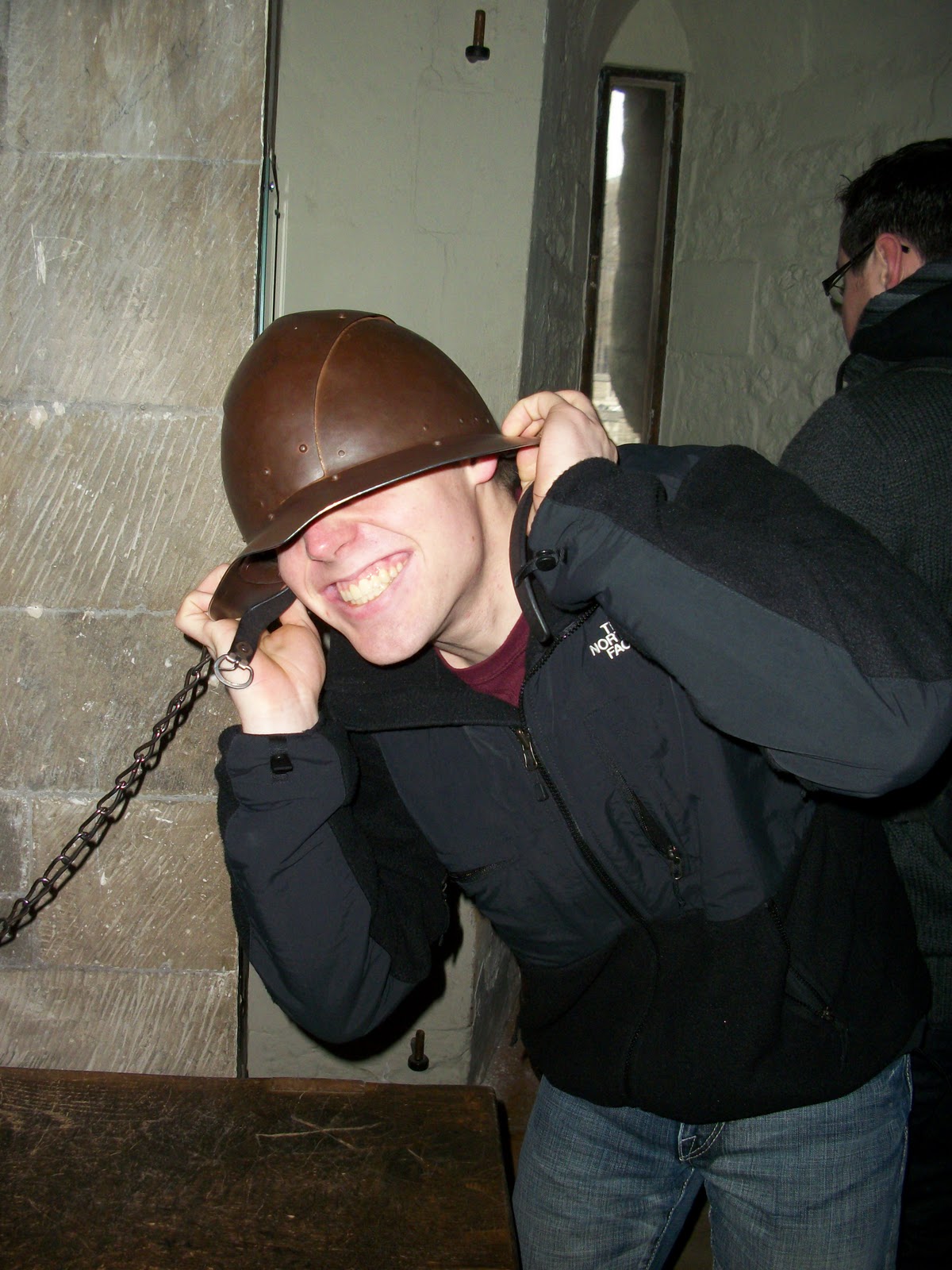
Erik trying on the 'guards' helmet
We spent nearly 2.5 hours in the Tower and would have been there longer if not for the closing of the complex. There are stories associated with each room and plaques describing each piece of armor and equipment. To read every element and to join one of the many free tours could occupy an entire day. I suggest visiting the site early and exploring every spot possible to more than compensate oneself for the price of admission. While I do not place too much value in jewelery, the array of crowns and artifacts echoes the majesty of the British Empire and its once absolute monarchy.

Leaving the Tower, we walked along the waterfront to intersect with the famed Tower Bridge. Unwilling to pay the steep price to scale its turrets, I satisfied myself with crossing its rather peculiar design of blue steel supporting arches, stone towers, and central drawbridge. I must appear approachable, for on the way I was stopped twice to snap photographs for other tourists.

Once over the famed bridge, we meandered along the waterfront, passing through the financial district with its modern glass-framed buildings, and back to the side with Saint Paul's Cathedral. I missed the nearby Millennium Bridge (pedestrian) the day before, so we walked to its center to look down the Thames and back to St. Paul's illuminated at night and magnificent for its Dome.

St. Paul's from Millennium Bridge
Full London Album

From there, we walked back to Rosebury in search of an affordable restaurant. Since Monday was Valentine's Day, we passed by plenty of expensive options catered to young couples. At one point we considered succumbing to the cheap 6 pound 'lovers special' at Dollar Bar and Grill, but quickly rejected it after noticing the red mood lighting and various 'romantic' decorations.

Instead we went back to Erik's dorm to see if any of his friends there new of a good place for dinner. Unlike the missing common room at Goldsmith, his hall boasts one with foosball and pool tables, as well as a bar. After scoring a couple to prevent owing him a pint after foosball, we played a quick game of pool with his English friends and set out for his room to see if Rickard wanting to grab dinner. Despite the stigmas associated with Rosebury's student-priced dining hall, we were convinced to check out the fajitas. To our dismay they were sold out, and so Erik and I left Rickard debating purchasing a pizza, while we set out to find a restaurant.

A few blocks from the hall, we came across an Italian Restaurant broadcasting the Inter Milan and Juventus match. The food was tasty, I opted for a steak while Erik ordered a pasta. Since Susan and John had earlier made a significant donation to the 'poor college student fund,' I was feeling wealthy enough to justify my choice.

Following dinner, we set out for pints at Spoons a local pub chain that boasts a variety of affordable micro-brews. After a couple drinks, I left the table to order the next round, and as is my nature, struck up yet another random conversation with a older guy at the bar. It turns out he was a site manager from near Manchester, and was supervising various projects in the city including the Olympic Stadium.  After I failed to return to our table, Erik came to the bar, which naturally brought the conversation back to the value of Rugby versus American Football - a discussion we had started earlier in the night.

After finishing our last call pints, we set out for Rosebury. Nearing the hall, we stopped at the adjacent small park and continued our discussion until the early hours of the morning. The long conversation had all the hallmarks of our debates at the Avalon over the summer that used to drive Paul to sleep before finishing.